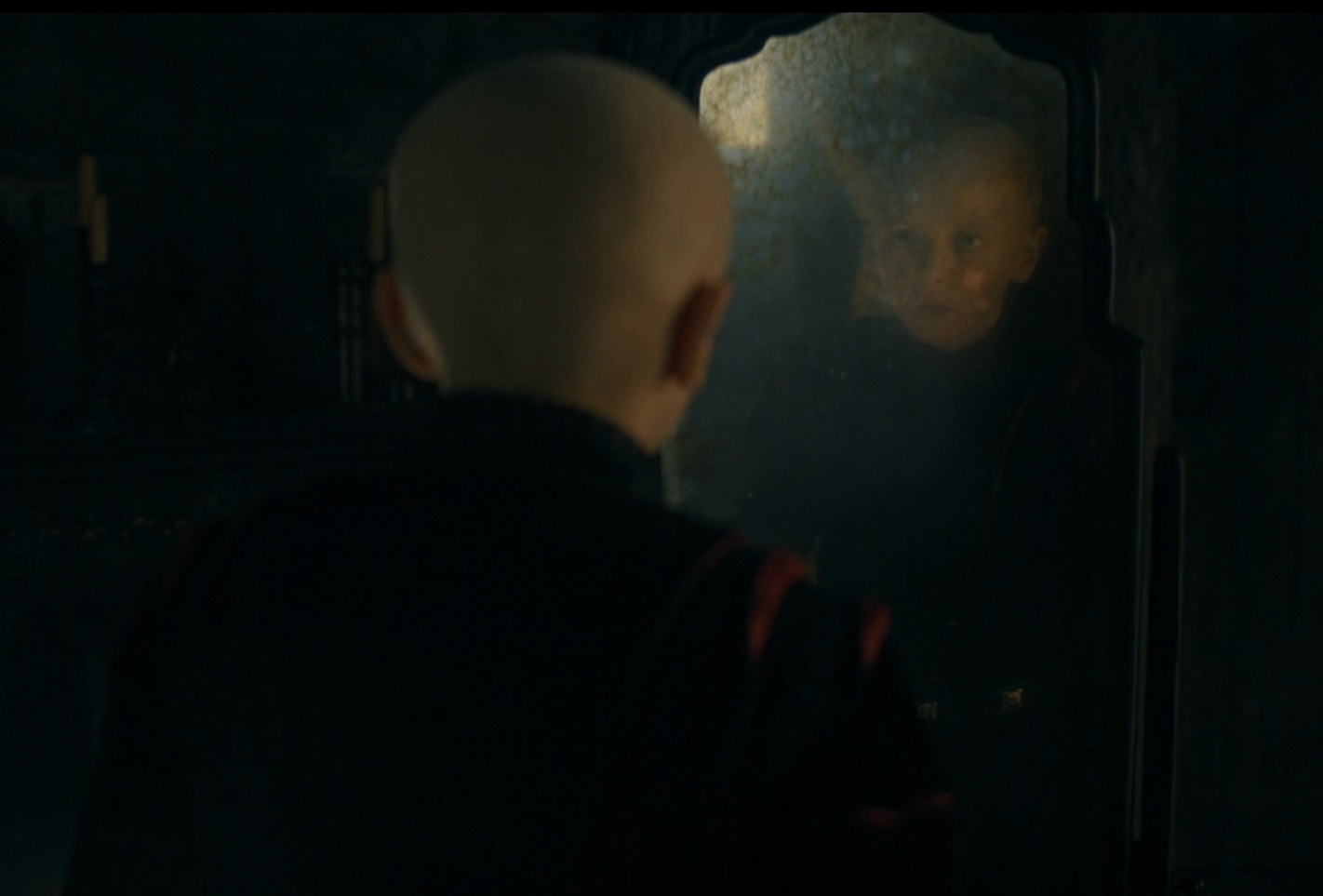
Hello, lovers of live puppet-based entertainment! This latest post about A Knight of the Seven Kingdoms (HBO’s stellar adaptation of George RR Martin’s The Hedge Knight novella) will be focusing less on Ser Duncan the Tall (I’ll be talking a little bit about him though), and more on a guy named Serwyn, whose story might have been told on the show by the Dornish puppeteer Tanselle Too-Tall.
But I don’t want to provide spoilery details for the show without giving fair warning. If you haven’t see A Knight of the Seven Kingdoms, you should give it a go, right now. I mean you, Peter.
Ser Duncan the Tall (or Dunk as I’ll now mostly refer to him) starts the series with a simple plan.
Get admittance to the Tourney at Ashford
Joust reasonably well
Profit!
Things dramatically turn when Dunk intervenes on behalf of Tanselle Too-Tall, a Dornish performer/puppeteer who irritates dragon-obsessed Aerion Targaryen by performing a play where a man in armor slays a dragon.
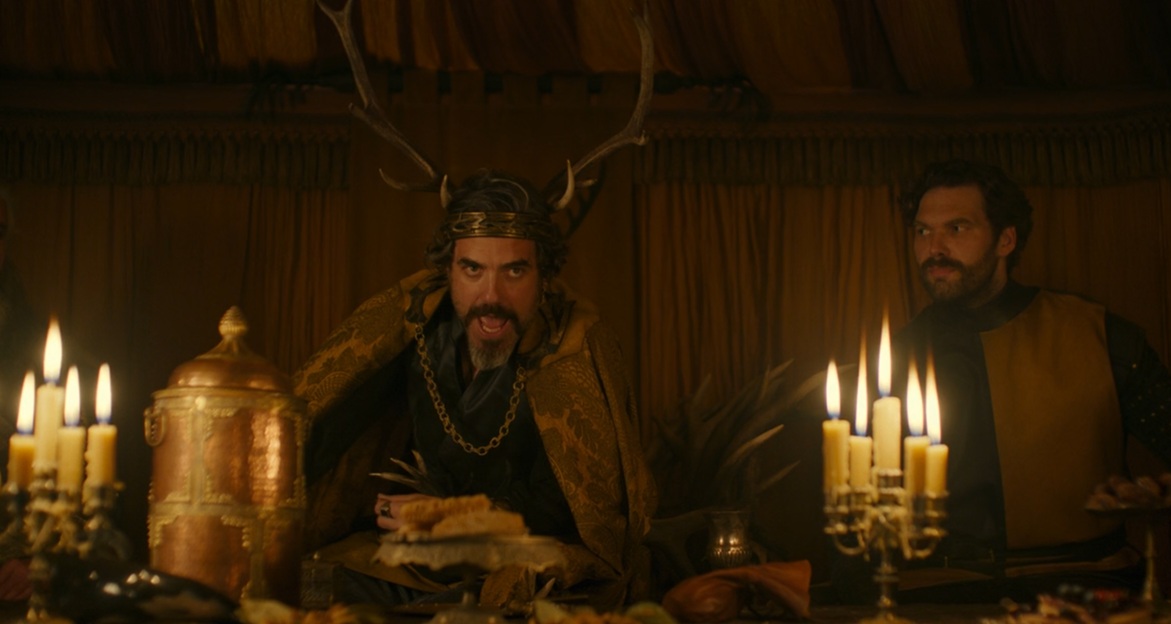
Aerion: That’s like so much treason, bruh.
The common interpretation is that the puppet show that offended drama critic Aerion was a telling of the time Serwyn of the Mirror Shield snuck up on the dragon Urrax and slew the great beast.
The details aren’t in the source novella, but are provided as an aside in the fifth book of the A Song of Ice and Fire series, A Dance with Dragons.
Tyrion realized he would do well to be careful around Haldon Halfmaester. “Every dwarf is a bastard in his father’s eyes.”
“No doubt. Well, Hugor Hill, answer me this. How did Serwyn of the Mirror Shield slay the dragon Urrax?”
“He approached behind his shield. Urrax saw only his own reflection until Serwyn had plunged his spear through his eye.”| — A Dance With Dragons, Tyrion III
Serwyn’s mirror shield acted as a sort of camouflage, allowing the hero to impersonate a dragon (since Urrax saw his reflection in the polished shield and misidentified the approaching Serwyn as another dragon.)
Serwyn does get a mention in The Hedge Knight, with Dunk thinking of him when remembering the tales of great knights and heroes from the songs he knew.
He thought back on all the songs he had heard, songs of blind Symeon Star-Eyes and noble Serwyn of the Mirror Shield, of Prince Aemon the Dragonknight, Ser Ryam Redywne, and Florian the Fool. They had all won victories against foes far more terrible than any he would face. — The Hedge Knight
Dunk is not alone in recollecting Serwyn and the company he belonged to.
Bran knew all the stories. Their names were like music to him. Serwyn of the Mirror Shield. Ser Ryam Redwyne. Prince Aemon the Dragonknight. The twins Ser Erryk and Ser Arryk, who had died on one another’s swords hundreds of years ago, when brother fought sister in the war the singers called the Dance of the Dragons. The White Bull, Gerold Hightower. Ser Arthur Dayne, the Sword of the Morning. Barristan the Bold. — A Game of Thrones, Bran II
A whole day with her prince! She gazed at Joffrey worshipfully. He was so gallant, she thought. The way he had rescued her from Ser Ilyn and the Hound, why, it was almost like the songs, like the time Serwyn of the Mirror Shield saved the Princess Daeryssa from the giants, or Prince Aemon the Dragonknight championing Queen Naerys’s honor against evil Ser Morgil’s slanders. — A Game of Thrones, Sansa I
“The smallfolk talk of him in the same way they talk of Serwyn of the Mirror Shield and Prince Aemon the Dragonknight. What do you imagine they’ll think when they see Barristan the Bold riding beside Robb Stark or Stannis Baratheon?” — A Clash of Kings, Tyrion I
Serwyn is interesting in that he’s never referred to as a knight, he’s never referred to as Ser Serwyn. He’s a mythical figure from the Age of Heroes although not before the Andals brought their Faith of the Seven and the notion of knighthood with them, if we take the stories Daenerys tells Daario as literal accounts.
He was never vexed by nightmares either. When Dany told him how Serwyn of the Mirror Shield was haunted by the ghosts of all the knights he’d killed, Daario only laughed. — A Dance of Dragons, Daenerys VII
So there are stories of Serwyn having killed knights, but not being one himself. (Unless everyone agreed that Ser Serwyn sounded weird and would drop the Ser, but that seems disrespectful and I’m rejecting that for this essay. Serwyn just isn’t a knight.)
The show explicitly (well, I think it is pretty clear) states that one of the dramatic presentations the Dornish puppeteers have in their performance wheelhouse is the story of Serwyn of the Mirror Shield, slaying a dragon.
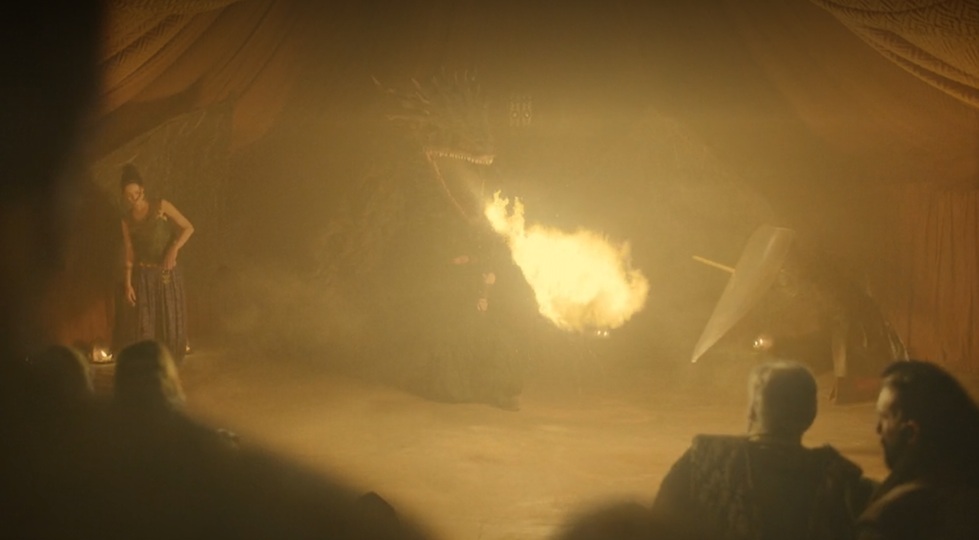
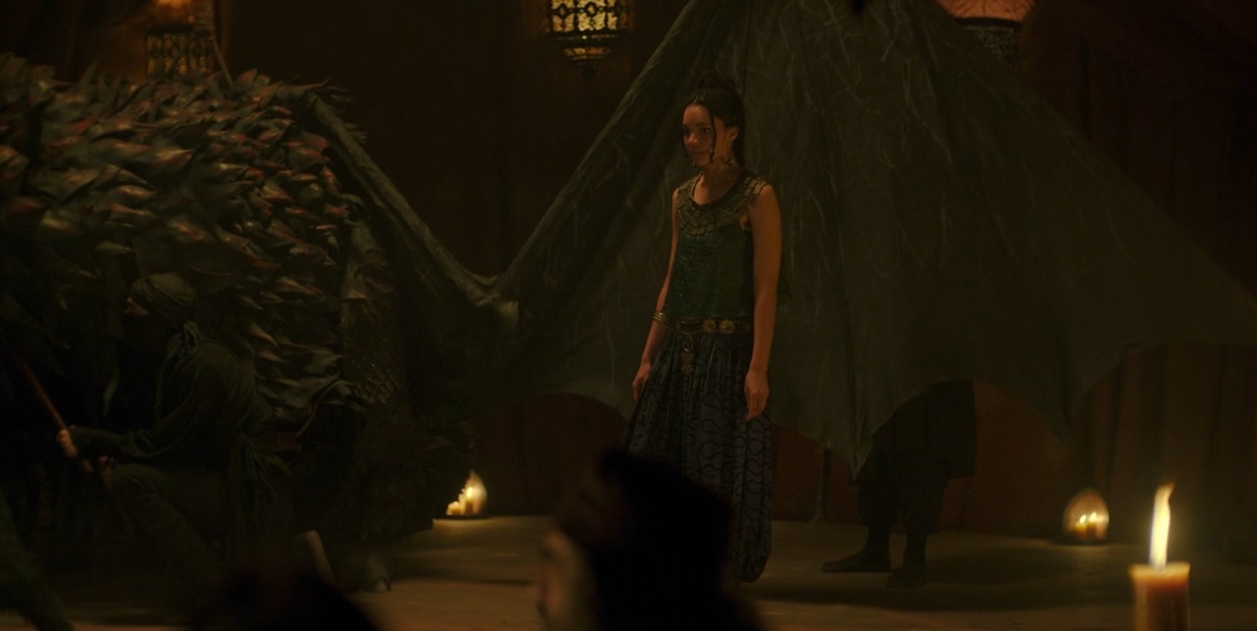
In the first episode, Dunk sees part of this performance, where Tanselle narrates in verse the important structural elements while a performer in armor, carrying a shiny reflective metal shield, maneuvers around an incredible dragon mega-puppet.
Our brave hero forges on, leaving all he knows behind/ A father and a friend, may seem the world unkind/ Fate has set his lonely path, through corridors of chance/ A boy from nothing risks it all, ignoring looks askance/ Perhaps he’s only stupid, holding fast his mirror shield/ Great honor his ambition, must keep a truth concealed/ For if his humble shape is bared, a foul and fiery demise/ Should the dragon discover none but a man in great disguise/ — A Knight of the Seven Kingdoms, Episode 1 “The Hedge Knight”
The hero, although unnamed in Tanselle’s verse, has a polished shield (it’s called a mirror) and is described as being in disguise – this clearly is a reference to the dragon’s own reflection being Serwyn’s “disguise” as another dragon.
In the third episode, we see Tanselle in armor, carrying the same mirror shield and acting as the hero delivering a killing blow to the oversize puppet, thus re-enacting the story Tyrion told to Haldon Halfmaester in A Dance with Dragons.
Tyrion: Point of order, Serwyn used a spear to stab Urrax in the eye, but I’m willing to overlook some changes in adaptation. Dave and Dan: We appreciate that!
(Why do we see two different presentations of the hero on stage squaring off against the dragon? One where Tanselle acts as narrator and one where Tanselle is the dragonslayer? I’m reminded of Shakespeare’s A Midsummer Night’s Tale. In that play, there’s a play-within-the-play, performed by tradesmen for Theseus and his court. The rude mechanicals start their play with a quick synopsis of the play that they are about to perform. This feels like a similar thing, that Tanselle might be introducing the play via poetic narration and then the play truly begins. She takes on the lead role as part of a more dramatic and detailed presentation. Feel free to dissent.)
Okay, but why am I spending a lot of time talking about this play performed in A Knight of the Seven Kingdoms?
As I’ve stated in previous AKotSK posts, there is an unresolved question if Dunk is technically a knight or if he just decided to pose as a knight without actually having been knighted by the ailing on-death’s-door Ser Arlan.
I believe that the inclusion of this play, specifically with the poetic narration given by Tanselle, is a point in favor of Dunk being an imposter, trying to earn glory via pretending to be something he’s not.
Serwyn is not a dragon, but driven by ambition and seeking glory, hatches a scheme to pretend to be a dragon, allowing him to approach Urrax for the killing blow.
Dunk, although he is as true a knight as one could ask for, in my view was never knighted by Ser Arlan, and is all-in on faking it till he’s making it.
The novella and the show both open the door for translating the plays being performed in the story directly onto Dunk and his specific situation. The Dornish puppeteers also perform a folktale about Florian the Fool and the lovely Jonquil. Dunk and Tanselle recite lines of dialogue from these characters, which demands comparisons and encourages us readers to consider all of the plays in a meta-context. If Dunk, our protagonist, is Florian the Fool, then he is also Serwyn of the Mirror Shield.
Serwyn is not a dragon (and possibly not a knight.) And therefore Dunk is not what he’s pretending to be as well.
The symbology from the play, of Dunk as Serwyn, cannot be ignored. Clearly, George RR Martin is telling us this in his secretive symbolic encodings that Dunk is just a rando kid, pretending to be a knight.
I’m sorry, my friends (and my dad) who believe Dunk was absolutely knighted legitimately by Ser Arlan, you’re wrong. GRRM is saying otherwise.
There, I’ve proved my point. Another iron-clad essay done. It would be heretical to think otherwise.
…
Or, have I proved my point?
The Self-Rebuttal
Hey, I do like considering the puppetshow of Serwyn of the Mirror Shield as a reflection of Dunk and his questionable knightly legitimacy. But it is absolutely wrong of me to suggest that this is true just because I like it. It’s also wrong for me to say that I have any insight into what GRRM thinks about in regards to the matter of Dunk’s legitimacy.
For starters, although Serwyn and his Mirror Shield are introduced as concepts in the first book A Game of Thrones (1996), the dragon-slaying isn’t spoken of until A Dance With Dragons (2011), published thirteen years after The Hedge Knight (1998). Until then, Serwyn is just a guy with a shiny shield.
In The Hedge Knight novella, the hero puppet fighting the dragon does not have his shield described. Maybe it was a mirror – and maybe not.
Dunk does thinks of Serwyn but it’s at the start of the novella when he is musing about old stories, not when he’s watching the puppet show. The hero puppet is consistently referred to as a knight in the novella’s narrative, which seems at odds if it was to be representing Serwyn – a legendary figure who does not seem to conventionally be a knight.
We get no backstory in the novella, no context about this play, so it’s hard to even say what George intended at the time he wrote The Hedge Knight – if the dragon puppet show is even about this Serwyn character, or even if the hero puppet is using a tactic to impersonate a dragon. There are no details about that.
Once George got around to writing A Dance With Dragons, he very well might have retconned in his mind a connection between Tanselle’s play and the details that Tyrion recites in the later publication. That would fall in line with George’s gardening-vs-architecting methodology. But that’s all speculation on my part.
Regardless if the puppet play was intended to be a winking commentary on Dunk from George, it serves a purpose even if Dunk was legitimately knighted as some believe. The dragon dying in the play is a straightforward foreshadowing of Baelor’s death, and of course there needs to be a reason to set Aerion off and create the conditions for Dunk’s troubles. It’s not required necessarily for the dragonslaying puppetshow to be a meta-conversation about Dunk.
Although the connection between the protagonist in the puppetshow and Dunk is not really over-established in the novella, I do have to acknowledge that the show really leans in on making that connection, particularly with Dunk coming in to the puppeteers’ tent in concert with Tanselle’s narration about a boy coming from nothing and seeking glory.
Tanselle: Perhaps he’s only stupid, holding fast his mirror shield/ — A Knight of the Seven Kingdoms, Episode 1 “The Hedge Knight”
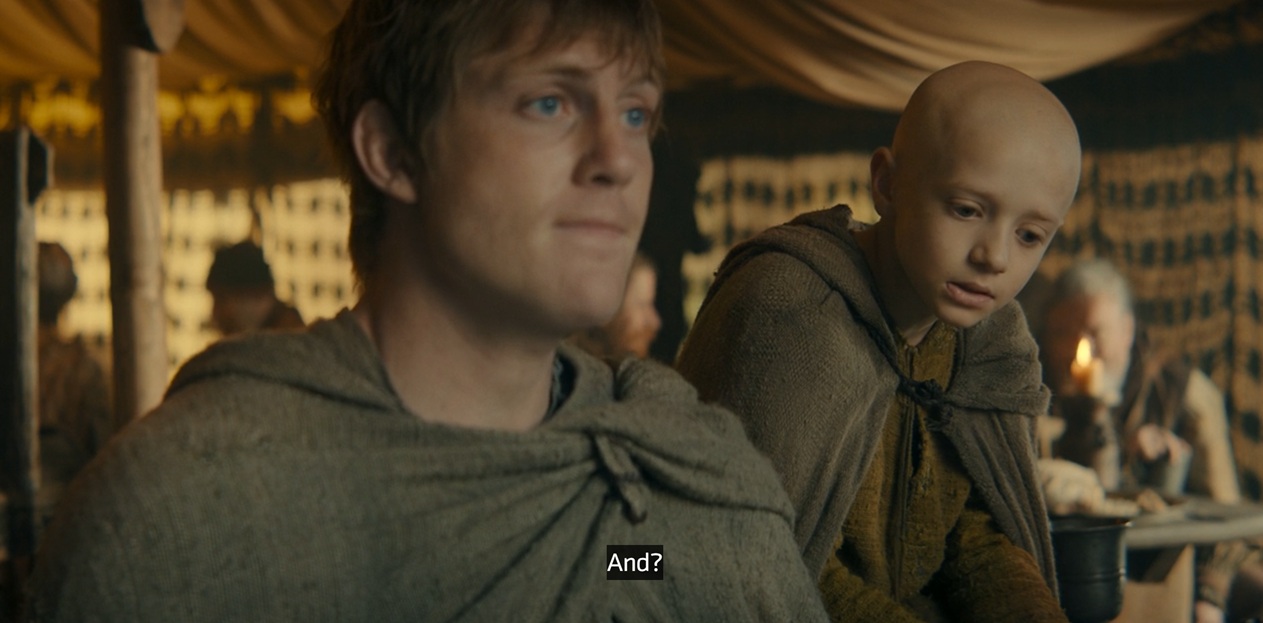
Dunk: Everyone’s always told me I was stupid. Egg: And? — A Knight of the Seven Kingdoms, Episode 2 “Hard Salt Beef”
Ira Parker, the showrunner for A Knight of the Seven Kingdoms, might be giving some signals that Dunk, like Serwyn, is pretending his way through things. Parker probably has an opinion on Dunk’s knightly status, but he took pains to keep the question open throughout the show (especially in episode 6 with Ser Arlan explicitly not drifting off into oblivion without knighting Dunk – at least not yet.)
We should assume that he doesn’t want to be the one answering that question definitively.
The possible symbology and theoretical connection to Dunk is an interesting thing to think about, but theories often don’t prove anything by themselves. Theories should be met with some critical thinking, and without taking surface impressions as given (which can lead to some bad results.)
Urrax: Maybe this is just a shield-sized dragon face coming to greet me. I’m pretty sure this won’t lead to ruin. Aerion: I’m pretty sure this lumbering oaf won’t be able to recruit six other knights in response to my demand for Trial of Seven. I’m sure nothing catastrophic will happen. Podcast Listener: Hmmm, maybe the original Night’s Watch were indeed a collection of undead green-seeing skinchangers, and to hear more evidence of that, I just need to contribute some $$$ to a podcast’s Patreon tier. Seems reasonable to me!
Anyway, readers of A Song of Ice and Fire love to engage in theories, and I encourage everyone to think about these theories critically, especially about anything that I might propose (which are always free, the only cost to you is the time spent reading, time you’ll never get back, mwuhahahah.)
E(gg)pilogue
Since you’ve read this far, I’ll grace you with another theory. The updated expanded puppetshow in A Knight of the Seven Kingdoms is not about Dunk at all (why must everything be about Dunk?) It’s about young Aegon Targaryen. He’s Serwyn in this example, pretending to be a regular penniless lad so he can squire for a knight.
Egg: What? That’s nonsense. “A boy from nothing” ? So I’m from nothing? Me: Egg, my dude. You’re a fourth son of a fourth son. That’s practically being from nothing. Egg: So, what’s my shield then? My disguise? Me: The mirror shield is the mirror you use when shaving your head, it’s your disguise.
Egg: Mind. Blown. Prince Baelor: Too soon, nephew. Too soon.
(Comments are always welcome. Super welcome! But if you want to talk spoilery Game of Thrones talk with me (also welcome) I’d invite you to visit my Safe Spoilers page on my backup blog. That way my non-book-reading friends won’t be shocked with foreknowledge.)
Images are from HBO’s A Knight of the Seven Kingdoms (obviously). I make no claim to any of the images, but some claims to the text (at least, the text that isn’t being transcribed from the show, the A Song of Ice and Fire series, and the Hedge Knight novella.) So there.
If you liked this article, thank you! I have all of my Game of Thrones related articles on my handy-dandy Game of Thrones page should you want to read more but don’t want to navigate around my site.